Instant Genius
Whether you’re curious about getting healthy, the Big Bang or the science of cooking, find out everything you need to know with Instant Genius. The team behind BBC Science Focus Magazine talk to world-leading experts to bring you two bite-sized masterclasses on a new subject each week.
New episodes are released every Monday and Friday and you can subscribe to Instant Genius on Apple Podcasts to access all new episodes ad-free and all old episodes of Instant Genius Extra.
Watch full episodes of Instant Genius on BBC Science Focus Magazine's YouTube channel.
Follow us on X: @SFIGPod
551
Neil Shubin: How do big changes in evolution ha...
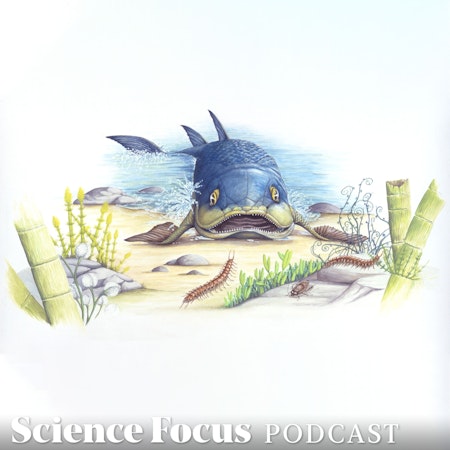
Evolutionary biologist Neil Shubin explains how life made the jump from land to water and how dinosaurs took to the air.
35 min
552
Your questions – Everything You Wanted To Know ...
Prof Jim Al-Khalili answers listeners’ questions about physics, the Universe and everything else.
32 min
553
Mysteries in physics – Everything You Wanted To...
Prof Jim Al-Khalili reveals some of the biggest unsolved mysteries. We talk about the plausibility of time travel, whether there are multiple universes and what we need to discover a ‘theory of everything’.
29 min
554
Energy – Everything You Wanted To Know About…Ph...
Prof Jim Al-Khalili tackles thermodynamics – the study of energy. Together, we unravel the idea of entropy, talk about the direction of time and muse upon the inevitable heat death of the Universe.
27 min
555
Quantum physics – Everything You Wanted To Know...
Prof Jim Al-Khalili demystifies the strange world of quantum physics. We discuss the key experiments, how quantum effects play out in the real world and, of course, Schrödinger's infamous cat.
30 min
556
Space & Time – Everything You Wanted To Know Ab...
Prof Jim Al-Khalili helps us get to grips with the big concepts in cosmology. We talk space time, relativity and, of course, the end of the Universe.
34 min
557
The Fundamentals – Everything You Wanted to Kno...
Prof Jim Al-Khalili breaks down the building blocks of the Universe and reveals what simplicity, beauty and elegance have to do with physics.
34 min
558
Everything You Wanted To Know About Physics, wi...
Let your curiosity run wild. No question is off-limits in this new podcast series from the team behind BBC Science Focus magazine.
1 min
559
Sandro Galea: What is the difference between he...
Sandro Galea explains the surprising factors that influence public health and which countries are doing it well.
33 min
560
Toby Ord: What are the odds civilisation will s...
Philosopher Toby Ord explains how, as a species, we are at a point in time that we are teetering on the edge of extinction, and what we can do about it.
32 min
561
Anthony Warner: Are we really too fat?
Chef and food writer Anthony Warner explains the science behind why we need fat, why fad diets are destined to fail, and what we can do to stay healthy.
44 min
562
Camilla Pang: How can science guide my life?
Bioinformatician Camilla Pang discusses how her neurodiversity has affected the way she works.
36 min
563
Kevin Fong: What happened to Apollo 13?
In this Science Focus Podcast episode, we talk to Kevin Fong about the new series of his award-winning podcast 13 Minutes to the Moon.
34 min
564
Aleks Krotoski: What happens to your data when ...
We ask social psychologist and host of BBC Radio 4's Digital Human Aleks Krotoski about life after death.
41 min
565
Professor Fay Dowker: What is the problem of qu...
Einstein’s general relativity explains gravity, but it contradicts quantum theory – is there a solution to one of modern physics’ greatest problems?
51 min
566
Jim Davies: How do you use your imagination?
What happens in your brain when your imagination runs wild? Cognitive scientist Jim Davies explains the science behind this extraordinary mental power.
36 min
567
Mark Miodownik: Are biodegradable plastics real...
Materials scientist Mark Miodownik explains why a knee-jerk switch from single-use plastic to biodegradable alternatives could actually make things worse.
31 min
568
Dr Erin Macdonald: Is there any science in Star...
Star Trek’s science consultant Dr Erin Macdonald talks about supernovae, what a science consultant really does, and whether warp drive is possible.
26 min
569
Adam Rutherford: Can science ever be rid of rac...
Geneticist Adam Rutherford refutes ‘scientific’ claims made to affirm racist beliefs, and tells us why science needs to stand up to racism.
36 min
570
Ross Barnett: Why should we be interested in pr...
Dinosaurs get plenty enough coverage. Instead, we take a look at creatures that lived in the Pleistocene era with palaeontologist Ross Barnett.
39 min
571
Samantha Alger: What can we do to save the bees?
Pollinator specialist from the University of Vermont Samantha Alger explains the threats facing our bees, and why that’s a problem for us.
41 min
572
Marcel Danesi: Why do we want to believe lies?
Linguist Marcel Danesi reveals the shocking truth about liars, why we lie and what we can do to protect ourselves from them.
23 min
573
Dr Becky Smethurst: How do you actually find a ...
Astrophysicist and Youtuber Dr Becky discusses black holes, reveals what astronomers do all day, and explains why we need to flood Youtube with scientists.
46 min
574
Hannah Fry: How much of our lives is secretly u...
Mathematician, BBC presenter and host of this year’s Royal Society Christmas Lectures explains how mathematics props up everything that we do.
25 min
575
Adam Kay: Is Christmas really the most wonderfu...
Doctor turned comedian Adam Kay gives us a warts-and-all account of what it’s like to work on the frontline of the NHS on Christmas Day.
24 min