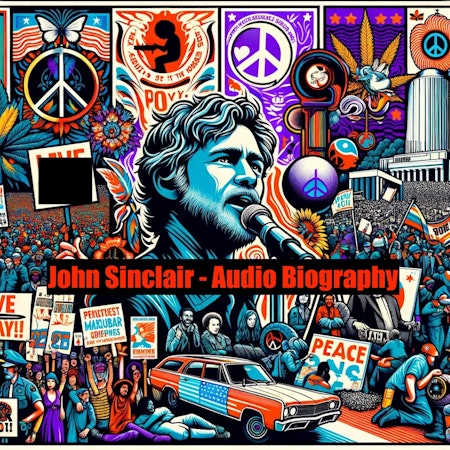
John Sinclair - Audio Biography
John Sinclair: A Life of Activism, Poetry, and Counterculture
Introduction John Sinclair, born October 2, 1941, in Flint, Michigan, is an American poet, writer, and political activist. His life's work has been dedicated to fighting for social justice, civil rights, and the legalization of marijuana. Sinclair's activism, which began in the 1960s, has left an indelible mark on American counterculture and has influenced generations of artists, musicians, and activists.
Early Life and Education John Sinclair was born into a working-class family in Flint, Michigan. His father, John Sr., worked in an auto factory, while his mother, Elsie, was a homemaker. Growing up in the 1950s, Sinclair was exposed to the music of jazz greats like Charlie Parker and Miles Davis, which would later influence his own artistic pursuits.
Sinclair attended Albion College in Michigan, where he studied literature and philosophy. It was during his college years that he began to develop his political consciousness, influenced by the growing civil rights movement and the writings of beat poets like Allen Ginsberg and Jack Kerouac.
Activism in the 1960s After graduating from Albion College in 1964, Sinclair moved to Detroit, where he became involved in the city's vibrant jazz scene. He began writing for underground newspapers and organizing jazz concerts, which brought him into contact with a wide range of artists and activists.
In 1966, Sinclair co-founded the Detroit Artists Workshop, a collective of poets, musicians, and artists dedicated to creating and promoting avant-garde art and culture. The workshop became a hub of counterculture activity in Detroit, hosting poetry readings, concerts, and art exhibitions.
Sinclair's activism took on a more political tone in the late 1960s, as he became involved in the anti-war movement and the struggle for civil rights. In 1967, he founded the White Panther Party, a radical anti-racist organization that sought to ally itself with the Black Panther Party.
The White Panther Party's platform called for an end to racism, imperialism, and the Vietnam War, as well as the legalization of marijuana and the release of all political prisoners. Sinclair and his comrades engaged in a variety of direct actions, including protests, rallies, and the distribution of underground newspapers.
In 1969, Sinclair was arrested and sentenced to 10 years in prison for possessing two marijuana cigarettes. His case became a cause célèbre for the counterculture movement, with celebrities like John Lennon and Yoko Ono speaking out in his defense. Lennon even wrote a song, "John Sinclair," which he performed at a rally in Ann Arbor, Michigan, calling for Sinclair's release.
Sinclair's imprisonment galvanized the movement to legalize marijuana and sparked a wider conversation about the injustices of the American criminal justice system. After serving 29 months in prison, Sinclair was released on appeal in 1971.
The 1970s and Beyond Following his release fro
This content was created in partnership and with the help of Artificial Intelligence AI.
1
John Simnclair - Audio Biography
7 min