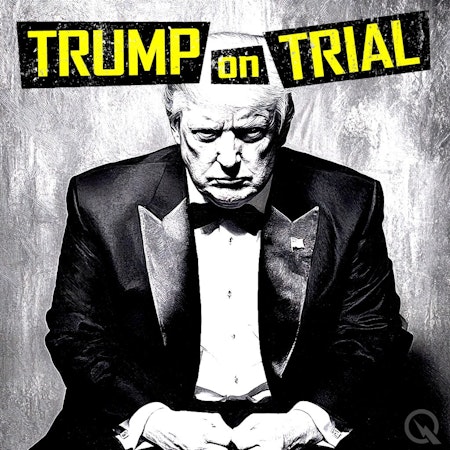
Trump on Trial
Trump on Trial is a podcast that covers the legal issues facing former President Donald Trump. Each week, we break down the latest news and developments in his ongoing trials and investigations, and we talk to experts to get their insights and analysis.We're committed to providing our listeners with accurate and up-to-date information, and we're not afraid to ask tough questions. We'll be taking a close look at all of the legal cases against Trump, including the Georgia investigation into his efforts to overturn the 2020 election, the New York lawsuit alleging financial fraud, and the various criminal investigations into his businesses and associates.We'll also be discussing the implications of Trump's legal troubles for his political future and for the future of the country. We're living in a time of unprecedented political polarization, and Trump's trials are sure to be a major news story for months to come.Trump on Trial is the essential podcast for anyone who wants to stay informed about the legal challenges facing Donald Trump. Subscribe today and never miss an episode!
This content was created in partnership and with the help of Artificial Intelligence AI.
1
Trump's Legal Battles Test American Justice Sys...
3 min
2
Supreme Court Tackles Trump Birthright Citizens...
3 min
3
Trump's Legal Shadow Looms Over 2026 Higher Edu...
Imagine this: it's late March 2026, and the legal world is buzzing with high-stakes drama straight out of a courtroom thriller, all circling back to Donald Trump's enduring shadow over American law and policy. While Trump himself isn't directly in the docket these days, his influence pulses through cases that echo his administration's priorities on transparency, borders, and federal power.
Let's start with the hottest flashpoint: higher education admissions. On March 11, a powerhouse coalition of seventeen states—led by Massachusetts Attorney General Andrea Joy Campbell—sued the U.S. Department of Education in the U.S. District Court for the District of Massachusetts. The case, Massachusetts v. U.S. Department of Education, targets the new Admissions and Consumer Transparency Supplement, or ACTS, part of the Integrated Postsecondary Education Data System, or IPEDS. This survey, born from President Trump's August 7, 2025, memorandum "Ensuring Transparency in Higher Education Admissions," demands selective four-year colleges report detailed admissions data by race, sex, test scores, GPA, income, and more—for the current year plus six prior ones back to 2019-20. It's designed to enforce the Supreme Court's 2023 Students for Fair Admissions ruling against race-based admissions. But the states cry foul, alleging violations of the Administrative Procedure Act, Paperwork Reduction Act, and E-Government Act—claiming it's ideologically driven, burdens institutions with massive paperwork, and skips required privacy checks and review panels. JD Supra reports that on March 13, Judge F. Dennis Saylor IV granted a temporary restraining order, pushing the submission deadline from March 18 to March 25, buying time amid threats of $71,545 fines per violation or loss of federal aid. Institutions nationwide are sweating—does the extension apply everywhere, or just plaintiff states like California, New York, and Illinois?
The Supreme Court wasn't idle either. Dykema's "Last Month at the Supreme Court" roundup for March highlights arguments in Montgomery v. Caribe Transport II on March 4, probing if federal law preempts state negligence claims against freight brokers—debates that could reshape trucking regulations with preemption vibes reminiscent of Trump's deregulatory push. Then, on March 2, in Mirabelli v. Bonta, the Court vacated a stay, blocking California's law that barred schools from outing transgender students' identities to parents without consent—a win for parental rights aligning with Trump's cultural battles.
Rutgers Law School's "Legal Issues to Watch in 2026" flags Supreme Court arguments from fall 2025 in Fernandez v. United States and Rutherford v. United States, potentially curbing judges' "extraordinary and compelling" discretion for prisoner releases—tough-on-crime echoes of Trump's era. Justia notes a March 25 opinion in Rico v. United States (Docket 24-1056), while YouTube streams capture House Judiciary Committee hearings that day in House Hearing Room 1, dissecting these tensions.
As May 12 dawns, these March fireworks remind us Trump's legal legacy is alive, clashing states' rights with federal mandates. What's next? Stay tuned.
Thanks for tuning in, listeners—come back next week for more. This has been a Quiet Please production, and for more, check out Quiet Please Dot A I.
Some great Deals https://amzn.to/49SJ3Qs
For more check out http://www.quietplease.ai
4 min
4
Supreme Court Citizenship Case, Connecticut Vac...
3 min
5
Trump's Legal Reshaping: SPLC Indicted, Birthri...
3 min
6
Supreme Court Sends Bannon Contempt Case Back t...
4 min
7
Trump v. United States: Supreme Court Challenge...
3 min
8
Supreme Court Battles Trump's Birthright Citize...
4 min
9
Trump Legal Battles April 2026: Supreme Court C...
3 min
10
Trump's Legal Legacy Dominates 2026 Court Decis...
4 min
11
Trump's Federal Election Trial Begins April 202...
3 min
12
Trump's March 2026 Legal Calendar: Hush Money C...
3 min
13
Trump's Federal Election Trial Faces April 2026...
3 min
14
Trump Manhattan Hush Money Trial Begins: What t...
3 min
15
Trump Faces Multiple Legal Battles Across Feder...
3 min
16
Trump Federal Election Interference Trial Begin...
3 min
17
Trump's 2026 Legal Battles: Federal Charges, Su...
3 min
18
Trump's March 2026 Trial Heating Up: Federal Co...
3 min
19
Trump's Multiple Criminal Cases 2026: Federal a...
4 min
20
Trump Faces March 4 Trial Date in Federal Elect...
3 min
21
Trump Election Interference Trial Begins: Feder...
3 min
22
Trump Federal Election Trial: Judge Sets March ...
2 min
23
Trump Legal Battles 2026: Supreme Court Gun Cas...
4 min
24
Supreme Court Blocks Trump's Emergency Tariffs ...
4 min
25
Supreme Court Strikes Down Trump's Emergency Ta...
3 min