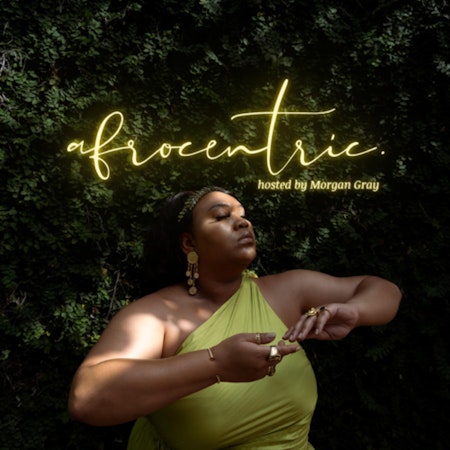
Afrocentric.

Mission: To redefine and expand the understanding of Afrocentrism by illuminating the deeper, often untold histories and lived experiences of the Black Aboriginal peoples of North America—those later labeled as African American. The podcast bridges these truths with the ancestral narratives of Africa, South America, and the Caribbean, fostering a renewed global appreciation for Black heritage, resilience, and cultural continuity.

Purpose: This podcast exists to challenge limited historical frameworks, such as the dominant 1619 narrative, by restoring depth, dignity, and context to the story of the original dark-skinned, swarthy peoples of the Americas. Through dialogue, storytelling, and scholarship, it seeks to empower listeners to see the continuum between ancient ancestry, contemporary identity, and future potential.

Embrace the Movement.

Join the Movement.

Afrocentric.

Education
History
How To
76
I am Such a Little Lady featuring Alex Gray
This episode explores womanism and how it challenges traditional feminism by centering the experiences of black women. We discuss the historical marginalization of black women in feminist movements, and how womanism offers a more inclusive and intersectional approach to social justice. We also examine the relationship between femininity and womanism, and how embracing femininity can be a form of resistance against negative stereotypes of black women. Join my guest, Alex Gray reestablish that we are nice, young ladies.
79 min
77
Freestyle 17: I Built The Table
This podcast episode explores the question, "what do you bring to the table?" in the context of black love and relationships. We examine the resilience of black love throughout history, while acknowledging the challenges that black women face in dating and marriage. We offer personal stories, insights from experts, and practical advice for building strong and healthy partnerships. This episode celebrates the strength and beauty of black love, and provides hope and inspiration for those seeking meaningful connections.
76 min
78
Freestyle 16: Ratt Williams
Hey there, podcast lovers! In this episode, we're getting real about the gritty world of street law and street code. That's right, we're talking about snitches and rats, and the complex web of loyalty, betrayal, and survival that underlies these controversial terms. We'll be exploring the history and cultural significance of snitching and ratting, and examining the ways in which these concepts have been shaped by social, economic, and political forces. So buckle up, and get ready for a wild ride through the underbelly of American culture. It's time to talk street law, street code, snitches, and rats, and we're not holding anything back!
78 min
79
Freestyle 15: How to Mind Your Black Owned Busi...
In this episode, we explore the importance of minding your business as a black person. We discuss the impact of gossip, rumors, and the spread of misinformation, and how it can negatively affect our communities. We also delve into how practicing empathy can help us better understand each other and build stronger relationships. Morgan shares practical tips on how to stay focused on our own lives and avoid getting caught up in other people's drama. Tune in to learn how to mind your business and cultivate empathy in your daily life.
62 min
80
old heads & young hos featuring Remar Tally
Let’s have a realistic and modern conversation about sexism and ageism in the rap music industry. From the objectification and sexualization of women in lyrics and music videos to the marginalization of older artists, these forms of discrimination manifest themselves in several ways throughout the industry. In this episode, my guest, Remar Tally and I discuss the impact of this discrimination on artists and fans alike, and the ways in which we can work to create a more inclusive and diverse space for all artists. Through interviews with industry experts and artists themselves, we aim to shed light on these important issues and spark a conversation about how we can work towards a more equitable future for hip hop and the black music industry as a whole.
72 min
81
Freestyle 14: The South Might Rise Again
The South Will Rise Again is a phrase referring to a possible re-uprising of the South. In honor of April being Confederate History Month, this episode is dedicated to comparing and highlighting the tragedies that have occurred and are still occurring in the American South. Join our hostess, Morgan Gray as she discusses current events, while explaining how new policies and legislation passed in the South were intentionally created to negatively impact minority communities.
81 min
82
The Black Man is God featuring MacChisedec Sallis
The Five-Percent Nation, sometimes referred to as the Nation of Gods and Earths, is a Black nationalist movement influenced by Islam that was founded in 1964 in the Harlem section of the borough of Manhattan, New York City, by Allah the Father, who was previously known as Clarence 13 X and, before that, Clarence Edward Smith. The Nation of Gods and Earths teaches the belief that Black people are the original people of the planet Earth and are therefore the fathers ("Gods") and mothers ("Earths") of civilization. The goal of this episode is to help normalize and educate people about the philosophy and attitudes associated with the The Nation of Gods and Earths from an Afrocentric perspective. Join my guest, MacChisedec Sallis, we discuss the mythology, mathematics, and methodology behind The Five-Percent Nation. Our prayer is that this episode will help you find the god within yourself.
65 min
83
Freestyle 13: Yall Know Tee Tee Old
According to my birth certificate, I turn 26 on the 9th of April. It's so weird to think about because half of me still feels 22 and half of me feels 73. It’s not a secret that Tee Tee is getting old. With this in mind, I thought it would be fun to share 26 lessons I've learned before reaching the age of 26. So join me as I celebrate 26 years of navigating the world as a black woman, obtaining wisdom, and budging bullets. Cheers to more life!
52 min
84
For the Souls of Black Children pt II featuring...
The total disenfranchisement of black children is a result of their age and race, but it prevents them from addressing the systemic racism that they confront every day. Black children are more susceptible to being led down the school to prison pipeline, compared to their white counterparts. It is time for our community to have another conversation about the importance of protecting, advocating, educating, and empathizing with black children. In this episode it is our goal to discuss the importance of educating black children as well as the addressing the issues and disadvantages plaguing our education system. Join my guest, Christopher B. Greene, as we pray for the souls of our black children, again.
89 min
85
Freestyle 12: Hoodoo You Think You Are?
Hoodoo is an umbrella term that describes the African-American traditions of spiritual healing, ancestral devotion, and protection. Largely historical examination of the practice of Hoodoo Conjure in America, including descriptions of its roots in Africa and Europe as well as elements of Native American traditions that have come together into a comprehensive whole over the history of the United States. Although Hoodoo has a negative connotation associated with it, it is derivative from and is heavily influenced by Christianity. With this in mind, the purpose of this episode is to provide an academic understanding of and more context to African American Hoodoo and the traditions and ideologies associated with it.
79 min
86
Vanilla ISIS featuring Mathew Myles
Although Black Americans represent 13% of the population, according to statistics we commit 50% of the murders. Moreover, 90% of black victims are murdered by other blacks Americans. This phenomena is often referred to as Black-On Black Crime.  The phrase, Black-On Black Crime is a Nazi dog whistle that white Americans use to generate hate and fear, to label our community as violence, as well as to justify crimes committed towards black Americans.  On the other hand, the United States is in the wake of an epidemic of white-on-white crime. Back in 2011, the most recent year for which data is available, a staggering 83 percent of white murder victims were killed by fellow Caucasians. Join my guest, Mathew Myles and I as we discuss the violence that is a part of white culture.
104 min
87
Divine Timing featuring Skylar Shields
The Divine 9 is a name used to refer to the 9 Black Greek Letter Organizations that make up the National Pan-Hellenic Council which was founded on May 10, 1930 on the campus of Howard University. The Divine 9 was originally to educate and uplift the Black community from racial inequities, as a whole, these organizations has stood the test of time. Join my guest, Skylar Shields, as we discuss the complexities, the modernization, as well as the progress of Divine 9 organizations, frequently asked questions about joining black greekdom, as well as Skylar’s personal experiences as a member of the Theta Iota Chapter of Phi Beta Sigma.
78 min
88
Afrofuturism: Black History with Black Historia...
Afrofuturism is a cultural aesthetic that combines science-fiction, history and fantasy to explore the African-American experience and aims to connect those from the black diaspora with their forgotten African ancestry. As we navigate through modernity while remembering the past, oftentimes it is hard to focus on the future. My guest Shonna Tillman and I will discuss the modern state of the black community in America, post Civil Rights Movement. Join us, as we daydream about what the future holds for the black community.
99 min
89
The Good Ol’ Days: Black History with Black His...
The Civil Rights Movement was a nonviolent social and political movement and campaign from 1954 to 1968 that swept through the nation. Many African Americans worked tirelessly to abolish legalized institutional racial segregation, discrimination, and disenfranchisement. While doing so, white supremacy groups were created to counteract this movement. While many will focus on the achievements accomplished by the prominent luminaries of that time, me and my guest Bria Young will discuss the atrocities and harmful ideologies created by white supremacy groups and lawmakers to disrupt the Civil Rights Movement. Join us as we reminisce on the good ol’ days!
101 min
90
Strange Fruit: Black History with Black Histori...
A new chapter in American history opened as the Thirteenth Amendment, passed in January of 1865, was implemented. It abolished slavery in the United States, and now, with the end of the war, four million African Americans were free. As a result, millions of African Americans began to build a new place for themselves in public life, actively confronting racial prejudice as well as economic, political and social challenges to create a Black urban culture that would exert enormous influence in the decades to come. Join our black historian of the week, Kymara Sneed, as we discuss the progress of the black community post Emancipation, the Great Migration, and the Harlem Renaissance viewed through an afrocentric lens.
74 min
91
For Those Who Chose the Sea: Black History with...
The Atlantic slave trade involved the transportation by slave traders of enslaved African people, mainly to the Americas. The slave trade regularly used the triangular trade route and its Middle Passage, and existed from the 16th to the 19th centuries. The purpose of this episode is to paint an accurate timeline of the enslaved person’s journey to the Americans while dispelling and correcting inaccurate myths surrounding American enslavement. Join our black historian of the week, Xavier Sivels, as we discuss the day to day life like for those who were enslaved and the atrocities that occurred durning American enslavement as we view it through an Afrocentric perspective.
75 min
92
TALKING CASH MONEY $HIT featuring Benjamin Park...
Black Americans experience far more precarious economic conditions than the American population as a whole. While the typical black household's income has risen over time, black households earn just 62 cents for every dollar earned by white households. The purpose of this episode is to inform the black community about the history of black finance and the modern black economy, while addressing the systematic disparities in finance for black Americans. Join my guest, Benjamin Parker and I, as we talk our cash money shit.
112 min
93
Freestyle 11: The Abundance of the Heart
It is well known that the black community traditionally passes down history orally. By word of mouth, black people were able to teach morality and life lessons, revive old traditions, and heal the trauma that passed down from generations. With this in mind, the purpose of this episode is to combat the narrative that “black people do not have culture” by showcasing the richness of our tradition of storytelling through the lens of African American folklore.
80 min
94
A Doctor in the Sick Room featuring Jessica Gray
Trust in health care among Americans has declined in recent decades, and it’s worse among African Americans. African Americans are more likely than whites to say they don’t trust their physician. In a poll, conducted in October of 2020, 7 of 10 African Americans say they’re treated unfairly by the health care system and 55% percent say they distrust it. Why?! The medical establishment has a long history of mistreatment towards African Americans — from gruesome experiments on enslaved people to the forced sterilizations of Black women and the infamous Tuskegee syphilis study that withheld treatment from hundreds of Black men for decades to let doctors track the course of the disease. Generations of racism and mistreatment at the hands of medical professionals have left many African Americans distrustful of the healthcare system. Join me and my co host for the episode, Jessica Gray, as we unpack over 450 years of trauma and mistreatment at the hands of the American healthcare system while providing tips to navigate the system as a black person.
87 min
95
Freestyle 10: Racism for Dummies
For many of you, the last time someone sat down and had a conversation with you it surrounded topics that involved birds and bumblebees. Today I wanted to have a more serious conversation about race and racism in America. Talking about racism is not an attempt to guilt or shame anyone. It is about spreading awareness so that it can be properly addressed. And if I were you, I would stick around to the end to hear me answer this nefarious question: Can black people be racist?
63 min
96
Freestyle 9: The Hueless Heroes
<p>After closely reflecting over 2022, I have come to the conclusion that the white community has a shortage of role models and heroes, and an extended supply of audacity. So, I have made it my New Year's resolution to help point your community in the right direction. I have come to this conclusion based on the fact that a handful of white, Americans believe that Critical Race Theory courses have the potential to create an environment that demonizes the offspring of American colonizers. So much so that their community is willing to erase roughly 400 years of creative work and history from the African American Community. This belief system raises many questions for the people on the right side of history. The main question would be: Why would the offspring of European Americans identify with the mindset of the oppressor and not the mindset of the abolitionist?</p> <p>So with that in mind, the purpose of this episode is to introduce to you, some of the good white people in American History. Those who denounced the evils of slavery and segregation. The pale people that went home and told their parents that white supremacy was evil.</p> <p>Not all heroes wear capes. In fact, not all role models have melanin. &nbsp;Some are just hueless heroes</p>
64 min
97
Gray(t) Minds featuring Alex Gray
As of 2021, the Black hair market is worth $1.6 billion and is expected to continue growing. Although the black hair care industry is extremely profitable, for many of the shareholders and business owners within this sector there is a lack of diversity of hair types. Moreover, many of the hair products that are promoted specifically towards the black community contain toxins that are hazardous to our health. Throughout the Diaspora, people of African descent are shamed for the way that their hair naturally grows out of their scalp. Leading me to wonder: How can we learn to love our hair when it is ostracized and critiqued everywhere we turn? So with this in mind, i would like to invite you to join my sister, Alex Gray, and I as we celebrate our natural hair journey while sharing our personal experiences with our hair. Because you can’t spell Afrocentric with the Afro. If I were you, I would stick around to hear Alex give amazing hair advice, because Gray(t) minds always think alike.
102 min
98
Freestyle 8: No Justice, No Peace
A brief overview of my life, as an activist and my journey navigating academia and infiltrating all white spaces.
94 min
99
Afrocentric: After Dark featuring Yolanda Kelly
The revolution will not be televised, but it will be recorded and uploaded on my podcast channel. What revolution? The black, female sexual liberation revolution that started in the 1950s, and influenced women to demand greater sexual freedom and control over their own bodies. Although the black, sexual liberation movement was spearheaded by black female luminaries, it has been counterproductive compared to the enduring stereotypes that promote the idea of black women being the Jezebel, or sexually immoral. Because of this long standing stigma, black women are often overly sexualized, dehumanized, and ashamed of their bodies. As a result, many black women believe misinformation about sex and sexual hygiene, while practicing slut shaming rhetoric about other black people who are sexually liberated. The purpose of this episode is to normalize conversations about bathroom talk and sexual experiences, and to re-educate the masses about appropriate sexual hygiene and sexual conduct. Join myself and my guest, Yolanda Kelly as we talk about sex. This episode is guaranteed to make you blush. Welcome to Afrocentric: After Dark
101 min
100
Morgan Gray's Big Black Bottom featuring Kamari...
It is a shame that in the year of our Lord 2022, that we must remind the black community that liberation and separation can not co exist. The lives of black transgender people matter. This is a wake-up call: racism and anti-trans discrimination together are having an appalling impact on black transgender people’s lives, and it has to end. The goal of this episode is aid in the humanization of the the black transgender community. This will executed by removing misinformation and negative stigmas away from the black transgender community. Join my guests, Kamari Jai Rose-Moore, Wavo, and Nicklaus Ross, as they humor me into showing my big, black, bottom.
91 min